
The Blue Mountains of eastern Oregon and southeastern Washington support an incredible and diverse mosaic of majestic forests, from dry ponderosa pine stands, warm with sun and the scent of bark, to cool, moist mixed-conifer forests of fir and spruce. These forests provide cold, clean water for salmon and other sensitive aquatic species and water towers water for downstream communities, farms and ecosystems. They shelter irreplaceable biodiversity and provide a key wildlife migration corridor between the Cascades and the Rockies. They offer a myriad of places to hunt, fish, and find quiet. And they are central to Tribal cultural uses and treaty rights.
This is Oregon’s largest ecoregion, an immense, varied landscape that reaches from the Cascades all the way to the Rocky Mountains. There are not many places like it.
There is still time to keep the Blue Mountains wild.
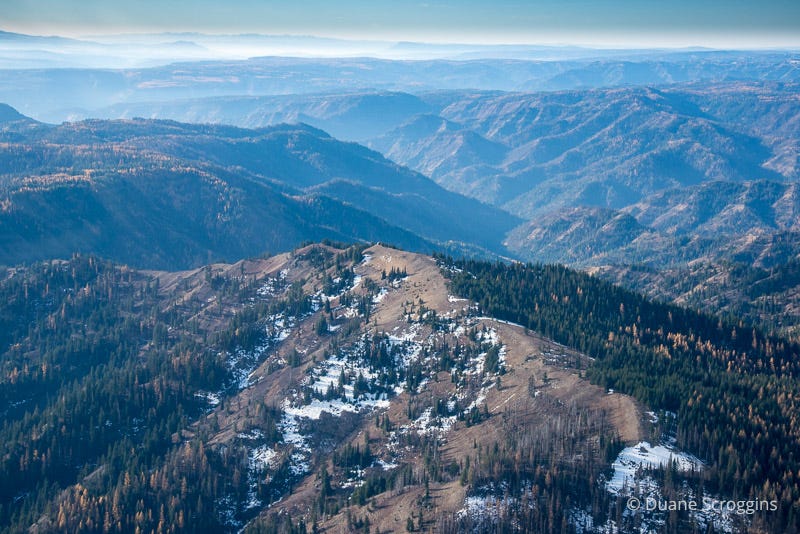
The large, intact forests of the Blue Mountains form an interconnected network of wildlands across the region. As the climate warms, protecting these landscapes only becomes more urgent. And the opportunity is still open: there is still time to keep the big blocks of forest intact, and to keep the corridors between them open so that species can move.
This vision has a name: a forest reserve system. It is the heart of what we are working toward.
A reserve system is simply a connected set of protected wild places: core habitat areas large enough to sustain wildlife over the long term, linked by corridors that let animals, plants, and clean water move freely between them. It is not a fence around the forest or a lock on the gate. It is a deliberate design to protect the wildest places that remain, connect them, and let the forest do what forests do best: store carbon, filter water, shelter life, and buffer us all against a changing climate.
We think this is something worth getting excited about.
It would be easy to look at the Blue Mountains and feel only worry. Logging pressure is persistent. Roads built for timber decades ago still fragment watersheds. Protections for the region’s largest, oldest trees are being removed. For those of us who love these forests, the work of slowing the damage can feel endless, and rife with a feeling of loss.
But there is another story here, a hopeful one, and it is just as true. The science is done. The maps exist. The wild places are still standing. What is missing is not knowledge or possibility. What is missing is enough voices saying “Yes!”
We are not starting from scratch. Scientists and Indigenous leaders in this region have spent years doing the hard work. The Camas to Condors partnership, led by Nez Perce Tribal members, has put connectivity at the center of its vision. Researchers including Dr. Beverly Law and Dr. David Mildrexler have published peer-reviewed studies that map, in detail, a realistic and achievable reserve system for the Blue Mountains — one that protects biodiversity, clean water, and the climate. The vision is not something we have to invent. It is something we can choose.
Right now, there is a once-in-a-generation chance to choose it.
The Forest Service is revising the management plans for the entire Blue Mountains, nearly five million acres of public land. A forest plan is the rulebook for a national forest: it shapes everything from how much timber is cut to whether streams and wildlife habitat are protected, and it lasts for decades. The current revision is moving toward a Draft Environmental Impact Statement, and with it a public comment period. That comment period is the moment the public gets to speak. It is the moment this vision can move from a scientific map to a real plan for real forests.
There is a bright future ahead if we can protect these places, and make them last for future generations.
— Dr. David Mildrexler, ecologist, in the film The Blues: Oregon’s Eastside Forests at a Crossroads
That is the future this site is about. On the pages that follow, you can explore what the reserve system is and the science behind it, take a tour of six landscapes worth protecting, learn why big old trees matter so much, see why protecting forests does not make wildfire worse, and find out exactly how the forest plan process works — and how to be part of it. The Blue Mountains are still wild. Let’s keep them that way.
Read Next: The Reserve System →
Ready to take action?