
DEEP DIVE
Drawing on the recommendations submitted to the Forest Service by Dr. David Mildrexler and Eastern Oregon Legacy Lands, here are six landscapes across the Blue Mountains where stronger protection would do the most good. By enlarging the reserves we have and connecting the ones we don’t, together they would turn a scatter of isolated reserves into a connected system.
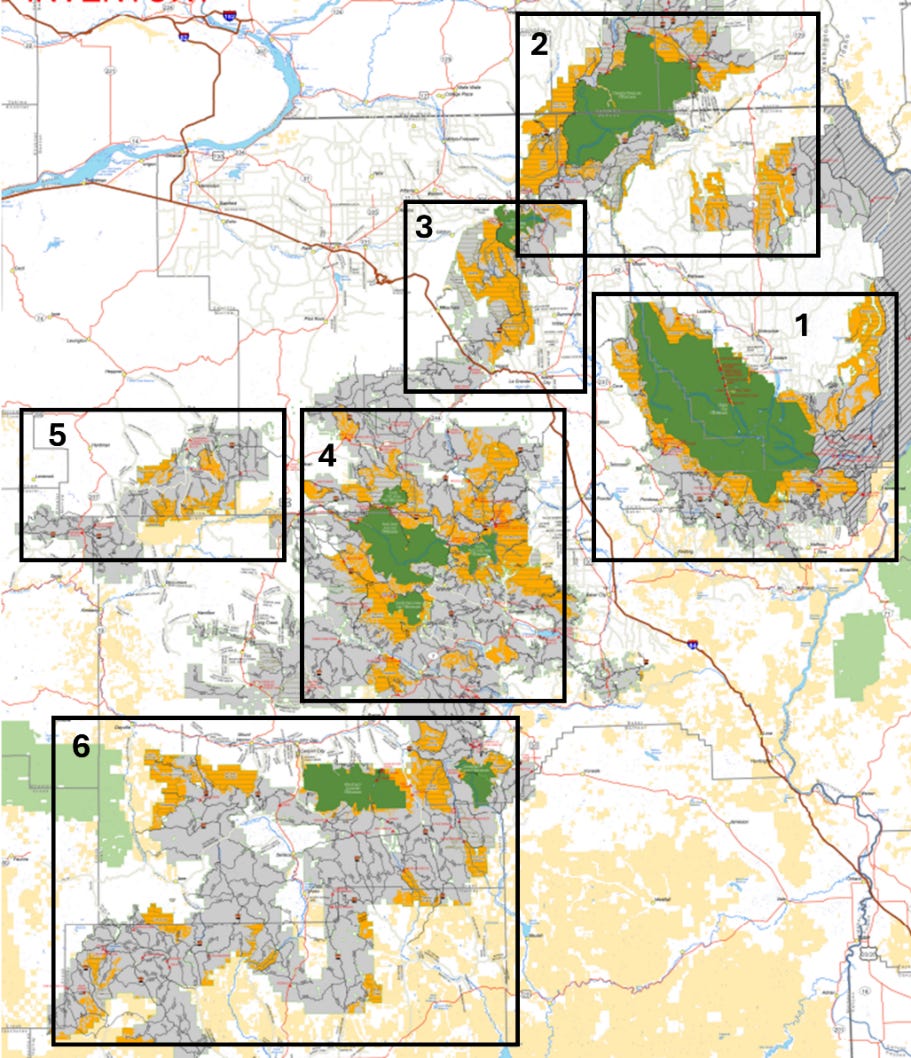
1. The Wallowa Mountains
Oregon’s grandest wilderness, the Eagle Cap, is ringed by large roadless areas that are essential to its health, places such as Huckleberry Mountain, Little Sheep, Boulder Park, and Upper Catherine Creek. These lower-elevation forests are rich in wildlife habitat and clean water, and they shield the wilderness at its edges. Nearby, the Lake Fork roadless area is the single most important link between the Eagle Cap and Hells Canyon: one of the most botanically diverse corners of the Wallowa-Whitman National Forest, where high- and low-elevation plant communities mix among old-growth ponderosa pine, Douglas-fir, and western larch. Protecting Lake Fork would join two of Oregon’s greatest wilderness areas into one connected whole.
2. The Northern Grande Ronde River
This is the northern corridor between the Hells Canyon and Wenaha-Tucannon wilderness areas — a country of deep canyons and clear rivers, and a landscape of exceptional cultural significance. Joseph Canyon anchors it, and the Indigenous-led Camas to Condors partnership is focused here, on the Joseph Creek watershed. Roadless lands along the Walla Walla and Grande Ronde rivers hold carbon- and species-rich forests and abundant cold water, woven through a complex patchwork of public, private, and Tribal land.
3. Meacham and Umatilla Canyons
An interlocking web of canyonlands that links some of the wildest and most remote country in Oregon. The Hellhole roadless area is one of the largest unbroken tracts of wild forest left in the Blues. These canyons are prized by backcountry enthusiasts, and parts have been recommended for wilderness in earlier planning efforts.
4. The North Fork John Day
The heart of the Blue Mountains, and the headwaters of the North Fork John Day — the longest undammed river in Oregon and a stronghold for native fish. The wilderness here is a four-unit complex, a working model for how multiple roadless parcels can be woven into a single reserve. The roadless lands around it, including the Elkhorn Mountains with their famous Crest Trail, are dense with high-priority forest and remarkable for their ability to keep the land cool and the water clean.
5. Skookum and Potamus Canyons
A quietly overlooked landscape on the “Blues front,” where high-elevation forests catch enough precipitation to support unexpectedly moist forest types. Texas Butte, Skookum, and Potamus Canyon hold large ponderosa groves and beaver habitat, and form a link from the Umatilla uplands down to the John Day River.
6. The Southern Blues Divide
A forest belt and wildlife corridor stretching across the more fragmented southern Blue Mountains, including the headwaters of the South Fork John Day River. Wilderness-quality landscapes like Aldrich Mountain, McClellan Mountain, and Glacier Mountain hold abundant high-priority forest and provide the connective tissue that holds this part of the range together.
Two ways to protect each place
Every one of these landscapes can be protected in two complementary ways. Some roadless areas are best protected as additions to existing wilderness, which makes our reserves larger and less isolated. Others are best protected as new wilderness areas, creating fresh core habitat where the map is currently bare. Used together, across all six landscapes, these two moves would knit the Blue Mountains back into a connected, resilient whole.