
What a forest plan is
A forest plan is the long-range rulebook for a national forest. It does not approve individual timber sales or trail projects, but it sets the goals, standards, and land allocations that every one of those projects must follow for the next two or three decades. It decides which lands are managed for timber and which are recommended for wilderness; how much protection streams, wildlife, and old trees receive; and whether those protections are firm “standards” or softer “guidelines.”
Standards are enforceable. Guidelines are not. That is why the exact language of the plan matters enormously.
Why this revision, why now
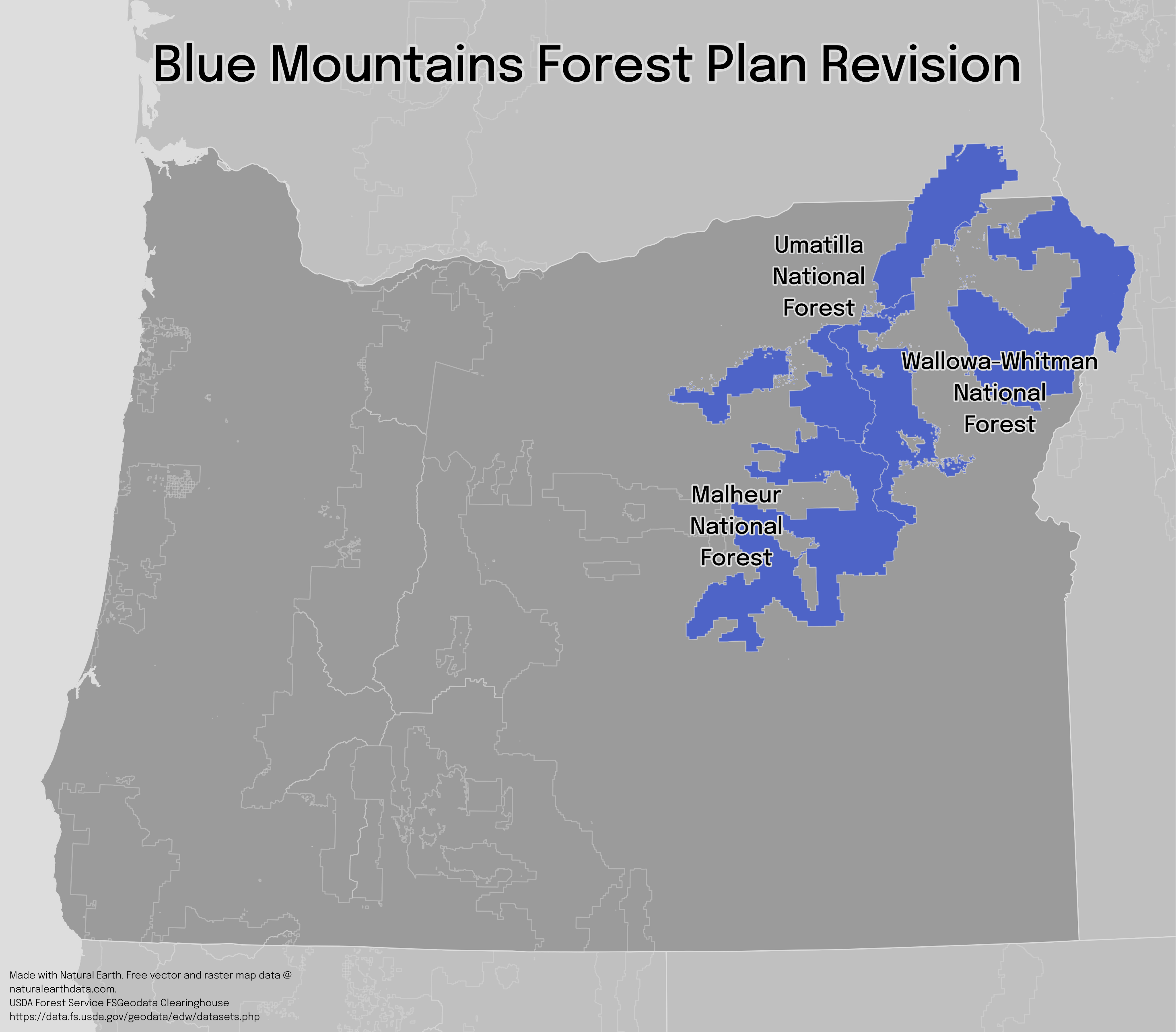
The current management plans for the Malheur, Umatilla, and Wallowa-Whitman National Forests date to 1990. The Forest Service has been working to revise them, on and off, since 2003; earlier attempts in 2014 and 2018 drew widespread objections and were set aside, and the process restarted in 2023. The three forests being planned cover about 4.9 million acres of public land, an area larger than Rhode Island and Delaware combined. A plan written now will likely guide these forests until mid-century.
Where the reserve system fits, and what is at risk
This revision will decide which roadless lands are recommended for wilderness, how inventoried roadless areas are managed, and whether the 21-Inch Rule protecting large old trees survives. In the 2018 version of this plan, the Forest Service identified roughly 70,500 acres for recommended wilderness. In the current proposal, none of those areas carry that recommendation. The scientists involved have asked a fair question: how can the very same lands, evaluated by the same process, suddenly no longer qualify? The public comment period is where that question gets asked, in numbers.
The timeline
The revision is now in its most important public moment: the 90-day public comment period for the Draft Environmental Impact Statement (DEIS), which ends on September 30, 2026. The DEIS lays out the proposed plan and its alternatives, and participation in the public comment period is required to have standing to object to the final Plan. A Final Environmental Impact Statement, incorporating public comments, is expected in early 2027.
Public comment is not a formality
It is easy to assume that a government comment period is just theater. It is not. Under federal law, the Forest Service must respond to substantive public comments, and a well-supported comment can change the final plan. The previous round of public input drew more than 1,300 letters and nearly 600 people to public meetings. Comments that point to specific places, cite the science, and ask for specific outcomes carry real weight: recommend this roadless area as wilderness; keep the 21-Inch Rule; make this protection a standard, not a guideline.
Ready to take action?